Thursday, 25 April 2013

Look Now(here)


Now, this is supposed to be one of the Great British Horror movies; a film with genuine psychological heft and dramatic momentum. That is certainly not what I could get hold of on the screen, where Hammer Horror Hamfisted Schlock was violently to the fore.

Donald Sutherland’s moustache bristled in a fake-horsehair manner. Vertigious shifts of focus and field bring a sense of incipient nausea, for no apparent reason other than flinging the audience through Venice as if on a bungee rope. Most of the cast appear blotched and blotchy, as if they need more sunshine, or have been reanimated in a brutal and abbatoir fashion.

The dramatic horror seems to be contained within rapid and incoherent pulls of focus and sudden lurches into eye-popping hysteria. From out of nowhere, high heels totter and dry ice billows from unlikely garrets and cornices. It would be funny if I hadn’t been feeling so much like vomiting.

There appeared to be an implicit critique of an irreligious English Countrie Class, though this was lost in the frantic and disjointed story. The whole business had me yearning for the outrageous jolts of pace and properly objectively unhinged points of view of a Dario Argento.

Sunday, 31 March 2013

Inside Outside


You need a big and robust idea to keep a piece of music on the stage and under the spot light if the composers you are celebrating are some of the most unreliable, skunked, smacked out, obtuse, and willfully obscure. The Outsider Music Ensemble managed this the other month at Café Oto by the simple expedient of recognizing that they themselves (the Ensemble, that is) are anything but Outsiders. They looked quite a lot like fresh faced and wired Music Theory MA students to me. Which meant that their vignettes by Moondog, Cornelius Cardew and Howard Skempton were beautifully digestible and programmed so as to be as independent-spirited as they could be,
seeing as the same people were playing them. There was an installationary air to the thing; a player piano spookily belted out Conlon Nancarrow and a gong solo got an airing from a gloomy corner. They know how to make an entrance too, to a hauntingly repetitive lovelorn chant. Inspirational, in the best way.

Tuesday, 26 March 2013

Blending In


"The Conformist" was a chillingly quietly designed film, everything undemonstrative curves and unfussy opulence. Marcello’s trajectory through the murder of a family employee when he was a child, a blank-eyed marriage and robotic, opiated pursuit of social and political success is hard to look away from; its exhausted, uncomprehending finale is thrown into sharp relief by the huge events taking place away from the screen. In the film, the characters are barely human, driven by self-serving, servile, pinched ideology that embeds them. There’s an unbearable relentlessness to the progress of the plot that’s entirely right. 


Tuesday, 5 March 2013

Absolute Power


Addressing authority, God, the government, the Big Other in cinema is always a business of exposure, of the lack of it.  The spine- chilling climax of the ‘Testament of Dr Mabuse’ is an object lesson in management of the essential disappointment of power. As with Hannah Arendt’s ‘banality of evil’, the scene of the cut-out dictatorial voice barking into a microphone in a concrete bunker is chilling in its emptiness, its resemblance to any lock-up garage.

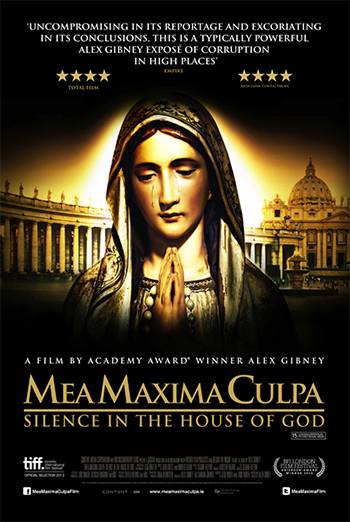
So ‘Mea Maxima Culpa’ is on very challenging ground in its documentation of a group of men from Wisconsin, who attempt to bring to account the Catholic priest who sexually abused them while pupils at a school for the deaf in the 10960 and 1970s. The film- makers skillfully elide the more general collision between the spurious ‘statehood’ of the Vatican and its associated legal inward-looking mindset and inability to address any ethics not centred on its own preservation. The characterfulness of the sign language is endlessly engaging, and the commentary of the New York Times journalist who had an inbox-ful of abuse for reporting them sympathetically was instructive: ‘When I heard that some deaf guys from Wisconsin were handing out photo-statted flyers outside a cathedral accusing a priest of abusing them, I know there was a story that needed to be told’.

Incidentally, yesterday I heard John Humphreys interviewing a senior British Catholic regarding the way in which the church has responded to accusations of abuse; Humphreys used the word “flippant” to describe the responses he was hearing and didn’t get contradicted or challenged.


“No” is a far more mediated, but equally encased telling of the story of the encounter between a socially embedded and compromised character and the brute force of power. Gael Garcia Bernal is obviously totally watchable on a cinema screen; using 1980s TV news film stock, the narrative chases him through the Chilean referendum, which delivered a decisive rejection of Pinochet’s military dictatorship. Bernal’s bemusement as the advertising strategies he clearly sees can be brought to bear on a political campaign, actually appear to work in the service of social goals he barely believes in, is wonderfully acted. Bernal doesn't so much as expose power in a revolutionary way, as throw into sharp relief just how mechanical and boring power is. 

Not so much as “speaking truth to power” as “being professional in the face of power”. 

Monday, 17 December 2012

Another Time, Another Place

I've got a dreadful feeling they won't thank me for blogging about the work together, but there was some real commonality between the intense engagement with place of Stacey's Makishi's 'And The Stars Down So Close' soundtrack and installation in Newington Green, and Vicky Ryder's memoir of growing up with hair "as straight as the Coventry canal". The voices in Stacey's travelogue through N16 are constantly referencing the language of the shops, street names, bars, gas stations that the walk passes through. This allows her to jump on from the names of buildings to the names of her inspirations and fears: Steinbeck and the nameless watchers and spies who threaten the free-dreaming and free-associating of her protagonist. This sets up an endlessly dance between the footsteps along the real Islington streets (its bricks, its film crews, it's history), between its bollards and phone-boxes (not booths!) to steps into dangerous thoughts, an acknowledgement that there is  'one thing thing more dangerous than an introverted book, that's a girl who knows how to read them'. It's almost a disappointment when we reach Newington Green and find that Stacey has cast her glittering spell across the entire space, from the Belle Epoque patisserie to the Paradise Fish Bar.

The unseen voyeurs on Stacey's walk spy 2 girls, one female, and one identity unknown; I imagine this uncertain creature is a twin of the narrator of 'Ey Up and Away' and she grows up in a place suffused with sex and gender but that doesn't give (her) any reason to take sides. Sticky hair creams, the stench of canal-water, prickly clothes, quick-as-a-flash but deep-as-bone humiliations pile up page after page with only the cut-glass vignette form to keep the reader safe.

Saturday, 27 October 2012

Digbeth Drama


Supersonic is again a brave festival proposition, removing the obvious rock and alternative crutches of the mass sing-a-long or worshipful archive grave-robbing, and relying on the hypnotick and primitive power of its forms to keep the audience from chin-stroking nerd-dom. We saw some properly cracking stuff, topped by Richard Dawson, an unprepossessing bearded Northerner, with a ululating wail of a voice and a tear-jerking way with a folk story. A gob-smacking sequence of key-changes as he worked his way through "Poor Old Horse" (a simple but affecting tale of the botched execution of aforementioned equine) were as powerful a musical device as we heard amid all the laptops and tone generators. His gag about being surrounded by the ghosts of various grandparents and pets, playing as his backing band, was the funniest thing we heard all weekend, outside of the dare-you-to-laugh "Black Star" refrain that Modified Toy Orchestra deployed.

There wasn't great deal of real onstage charisma if truth be told, though what there was, was electrifying. Jarboe, for me, has been a spectral presence known only from the "Burning World" Swans LP and the terrifying "Anhedoniac". She took the very simple but appallingly effective route of just standing onstage and singing the songs; with the eye-rolling and entranced delivery she has, this was more than enough to grip. There are matter-of-fact lyrical gestures towards barely-imaginable torment and heart-stopping devotion, which Jarboe can deliver like a public service announcement.

Rock is a tired and tiresome form, so needs something de-stabilising to jolt it beyond cheesy posturing (yes, Six Organs of Admittance, I'm talking about you). The babyish and fraught contortions of the Doomsday Student (bad name, good idea) vocalist was the only convincing rock stage incarnation of the weekend. He gibbered, plucked, arched, grasped and groped while the band delivered a harsh traumatised punk rock, knowingly stylised and sleekly aerodynamic.

The finale was well-chosen by the curators; I only know Oxbow from barely-comprehensible inky reports of muscular performative confrontation. On this evidence, they've had criminally poor coverage: a stark and rhythmic string section gives the declamatory and distressed vocal plenty of room to manoevre, the gasps and guttural groans in the delivery all too close for comfort.

Camera Angle


These are two gloriously cinematic films, that certainly wouldn't have justice done to them on a television screen. Andrea Arnold puts an astonishing weather-beaten array of natural greens, greys and russets into the frame, and even squares off the frame itself to heighten the sense of claustrophobia and to avoid opening up the film to an easily-delivered vista-of-nature. Her camera follows Heathcliff from beating to hillside to stable, punctuating the barely-imaginable journey Arnold charts for him, from act of charity, to dark obverse, to return of the repressed, with sudden, harsh, raw panoramas.

It was a crying shame that a gruesome pluck-fest of a track by Mumford and Sons was allowed to spray itself over the final few frames and reduce my memory of parts of the film to nothing better than an impressionistic folk music video styled by Toast's Moorland Farm aesthetic.

Lynne Ramsay (maker of the glorious Morvern Callar)