Sunday, 20 June 2010

Changed The Future

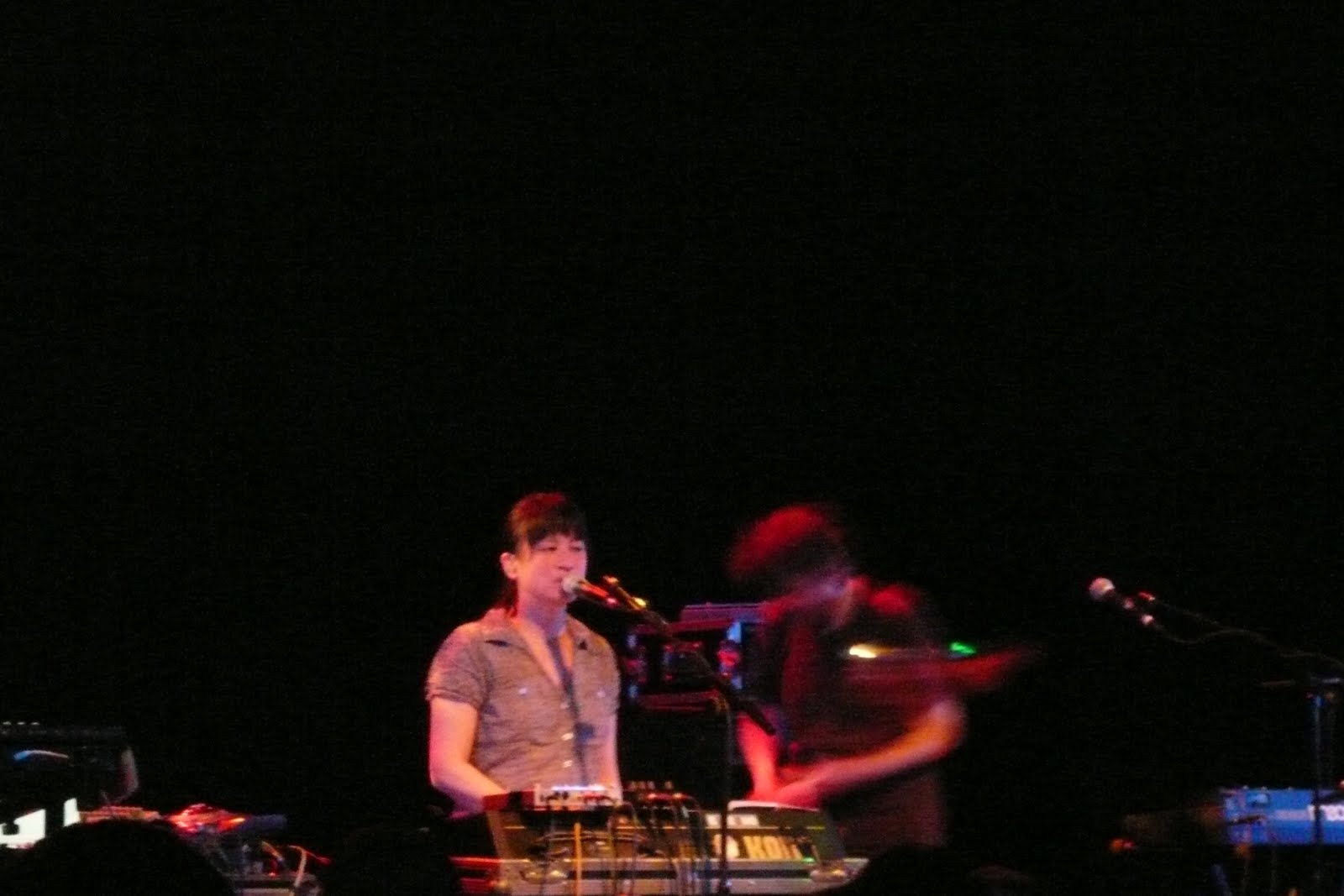
With Yoola, Gail, John, and Heidi we went to Brighton to see Lali Puna. This is a brilliant example of a group that is greater than the sum of its parts: Three fairly anonymous, charisma-free German rock-indie types with a drum kit, a bass guitar, and a heap of sampling kit. They are fronted, if that's not too crassly a rock role to be cast in, by a continuously nervous woman playing a sampler and a keyboard. The vocals are pale, repetitive, non-sequiturs and opaque sloganeering imprecations. It has a completely immersive and hypnotic effect, as if looped from a radio station that had ceased to be inspected by the sponsors some time ago.

I remember seeing Stereolab in a tiny hall somewhere in Hackney in about 1991, and this show had a similar effect; songs in the form of communiques or sonic postcards, a total lack of Rock Action, a quiet but compulsive buildup of persistence of form. It's completely refreshing to feel so un-performed-at but still entranced.

Land Locked Jazz


To obvious English ears, Eastern European music has a perceived tendency to the wild, psychotic, deranged, threatening. Of course, that only tells us so much about the elements of the English psyche that have been firmly denied and/or projected onto foreign musics.
These two groups were great fun; engaging, dedicated to their respective sounds, with no attitude toward their audience other than appreciation that they had one.

The bearded singer of Uz Jsme Doma made an excellent introduction: "It's great to be playing here in London at our first concert in the UK. However we have played in 57 different countries up to this point, so let's not get too excited about that..."

A couple of wild and extremely drunk Czech youths gyrated in front of us, ensuring a decent sized cordon sanitaire around them as those protecting their eye-wateringly expensive lager moved aside.

The aforementioned Uz Jsme Doma (Now We As At Home, my Czech-descended friend Simon tells me) were a bracing blast of punky post-Beefheart, with an excellent song that sounded like it was called "Siva A Schiva". That's unlikely to be real Czech there, though. They also did a nice shouted ballad about the time when there were Czech seafarers.

Much of the audience departed about then, including about half our compadres, muttering about "I ****ing hate ****ing jazz, you ****ing know I won't ****ing listen to it".

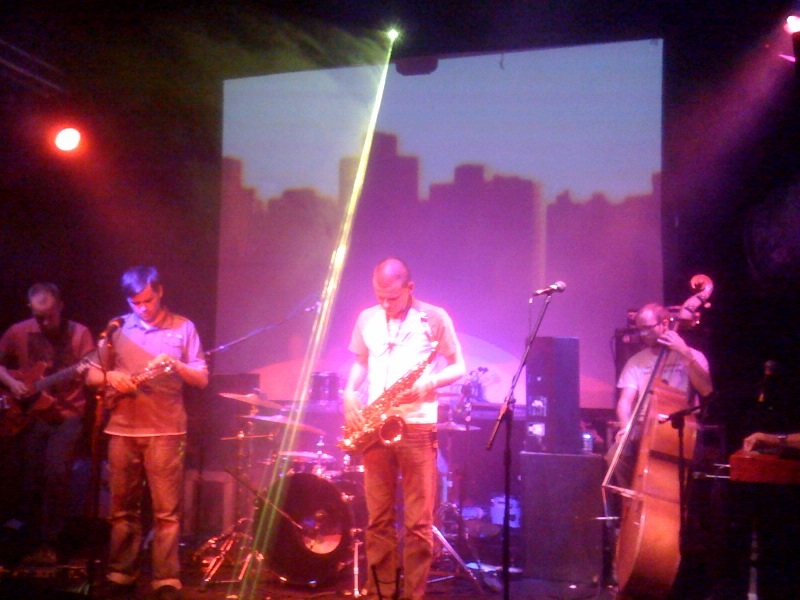
I really have no critical language to talk about jazz, which I think helps. The Contemporary Noise Sextet were just a very listenable modern jazz group. Drums, piano, and bass set up a rhythm: saxes, horns and guitars strike up a pleasant 5- or 7-note melody; melody breaks down into freeform soloing; city-scape back-projection works nicely with this: horns come back to the melody again, via some gurning from the guitarist and some so-happy-it-hurts smiling from the pianist. Simon and I kept wondering: Shall we make a run to the pub? No, let's catch one more by this lot.

Monday, 31 May 2010

Indian Ink

There's a luminous kind of writing, which creates a memory as if from one of your own dreams. It's troublesome to read, though, because I now think I have been to Venice during a Biennale, and Varanasi in the off season. Dyer seems to be writing about either someone else's story that he's convinced is his own; or about a dream he is yet to have.
Geoff Dyer is always very dryly funny, self-deprecating (when you know the character is his own cipher), and always puts you in the room. In "The Colour Of Memory", I was in the Brixton pubs and flat-shares that his characters rolled through. In this novel, I was in the heaving, Bellini-swigging tents of ego-fuelled installations.
Strangely, the second section set in India, is less powerful. Perhaps because I've been there for a little while, and the scenes have no dream-space to live in within my own memory. No room in the ethereal.

Saturday, 15 May 2010

Zestless City


We were at the ICA recently, hoping for more of the widescreen, Little England Writ Large, almost autistically densely researched "London Orbital". Or at least some of the vivid observational and psychogeographic travelogues that Ian Sinclair dies so well. When his schtick works, it challenges you to see your own neighbourhood with the intensity of the foreign traveller or the manic anthropologist.

However, what we got was a high point of Sinclair reading from 'The Rose Red Empire', a beautiful passage drawing his own history as a flaneur, his partner's life alongside him, the research threads sewn into him by his friends, and the ever-present ghosts of Hackney's history.

After that, things went downhill rather drastically. Stewart Home could not get through a sentence without reference to his True Punk roots, or get away from a camp, stagey, verbose lecturing style. We all write texts essentially telling our own story louder than our subjects, but we do try to keep the Walter Mittyisms and name-dropping to a minimum, if only so that our audiences don't get the overwhelming impression that we are trapped in 1977 with a pocketful of SWP pamphlets and a Crass LP for interpretive tools. To hear Home talk, anybody would think he was a motormouth standup with no jokes and trapped in an orbit around a couple of memories of gigs at the Clarendon.

Ian Sinclair, sadly, was barely better. There was a dreadful encroachment of glistening-eyed memorophilia, beamoaning of practically every effect of the last 25 years. His riff on the Ballardesque fate of the Athens Olympic site absolutely honked.

Surely the task here in London is to generate the tools and language to capture the torrential and n-dimensional flux of developments, and to identify the flow of events around the built environment, be it fragile, irresistible or vanishing.

London's ghosts are going to be living in a louder world; they haunt cultures and traditions all over the world, so whining about the vanishing of the pub where someone's mum met someone who wrote teenaged Trotskyist manifestos is only ever going to come over as the most parochial backward-looking nostalgia.

The reason that "London Orbital" works so beautifully is that there is a powerful sense of the history of place being acted out, the making-itself-felt of the past, without the sepia-tint sense of a wish to return to it. London has a terrifying and unique ability to remind you of yourself, to cut you down to size, to confront you with episodes and scenes that you might have forgotten, or wanted to; to re-cast itself as a constant character in your life.

As place becomes contested and congested, as locality becomes overshadowed or emptied by the virtual and viral, as public space is redefined and colonised by commercial requirements, a psychogeography of London must resist the temptation to become inward-looking and nostalgic.

Wednesday, 14 April 2010

Auto Destruction By Appointment

There's a wonderful scene halfway through this novel, in a car during a heavy, wet snowstorm. The characters are stranded, one worrying about how long the engine will run, how long the heater will work, how far it might take to walk to a store through the clogged and draining snowdrifts, whether they might be hit and killed by a snowplough if they abandon the car. The other character sucks Chupa Chups and idly fantasises.

A nameless narrator preys on the lonely and directionless, two brothers bicker and fight over a girl who is intrigued by neither of them. The novel is fastidiously and thoroughly soundtracked, and there are no accidents in it.

Tuesday, 13 April 2010

Celluloid space-time


All the films I've seen recently have had a fraught or effortless relationship with space; space for events to occur in, space for characters to be in, space for events to flower in naturally, and not be cattle-prodded into motion by the demands of plot or 'action'.

I was thrilled to discover that the opening line to the beautiful Italian pop song "Rosetta e Cioccolado", from the soundtrack to 'Conseguenza dell'Amore' features a request for raspberry syrup.

It's a harsher, more gnarly film than I recalled from the cinema several years ago. Titta di Girolamo is more of a cipher, restlessly and fruitlessly twisting the strands that surround him. The scene in which he bluffs a Swiss bank into giving him £100,000 by simply sticking to his story that he had it when he came in, is gloriously offhand. Di Girolamo is sat in an upright chair, facing a nearly-drawn curtain, smoking languidly. A bank manager stares furiously at his clerks as the total they count up to falls a hundred grand short time and again. Titta smokes on, faking obliviousness.
_________________________________________________________

"The Double Life of Veronique" appeared to me to be one long dream sequence with the logic of a character study. The light, sudden unpredictable leaps of location, camera movement, focusing of peripheral characters in their rooms, are beautifully woozy and impenetrable, slightly threatening. It was the inverse or mirror image of the 'proper' movie, that might use dreamy techniques to tell the 'actual' story. Here the dream was the story, and the two Veroniques were broken up by the force of the fantasy she was living out.

____________________________________________________________

"Born Into Brothels" is a completely compelling documentary about the efforts of an American photographer who arrives in Bombay to make a photo essay about the women working in then sex industry there; once in situ, she realises that the children born to these women (and heart-rendingly, kept from school or college with the connivance or collusion of their mothers) are more urgent in terms of engaging subjects than her photo essay would have been. She gives them all disposable cameras, and teaches them to take pictures. The Bombay of the film is a seething, asymmetrical, Escheresque dimension. Several sequences take hand-held footage as
the camera rushes through alleys, rooms, cramped quarters, plunging the viewer into a space in which unimaginable sacrifices of motherhood and childhood are made without a blink.

__________________________________________________________

Sunday, 4 April 2010

"You Ain't From Around Here"


"Let The Right One In" is almost certainly being remade and ruined in Hollywood as we speak. It's a brilliantly grey-white, muddied-snowfield of a film about the messy and contradictory and awkward and relentless business of being foreign and Other. The vampire element is wonderfully submerged within the alcoholism, teenaged fascination, petty small-town regrets, fears and revenges.

The snow is often slushy and dirty and scuffed and stained with mud or road grit or blood. A housing estate looks efficiently made, but essentially cheap, and probably poorly insulated. Sudden silences and empty schools after hours are cavernous, charged and active characters within the visual population of the film.

Plainly, there's an allegory for the disorientation and alienation of the immigrant, or stranger experience. It's never over-egged though, and the disappointed, pinched lives of the locals are well drawn in some lovely drinking scenes.

When the two children first meet, there's a beautifully awkward adult moment; only she knows why they can't be childhood friends, and they are both just ready to feel there is more than just being friends. She is hanging from a brutal metal climbing frame at her first appearance in the scene, and dismounts from it as she begins to speak. It's the only time we see her purely framed as a child in the film, and as soon as she speaks, the spell of her childhood is broken.