Serious issue; ghastly, vacant film.
Saturday, 7 December 2013
War Is Hell
Serious issue; ghastly, vacant film.
Sunday, 29 September 2013
Island Mentality
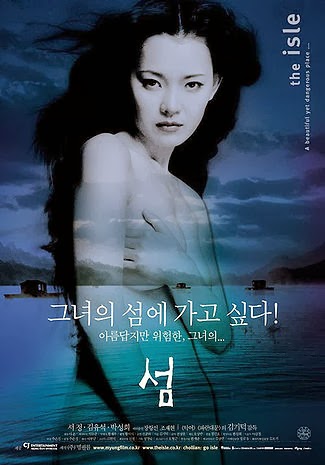
This is Kim Ki Duk's bizarre isolationist universe of misogynist fishermen, smalltown prostitutes and a charged, mute female Charon figure. Animals are smacked, handfuls of fishhooks are swallowed and inserted, vengeful jealousies flare out of nowhere, attempts at tendresse are trampled in a clatter of outboard engines and scooter motors. Grey rain and light fogs obscure motive and consequence.
Song Kang-Ho as Policeman
"Tell Me Something" is the story of the unforgotten crime of sexual abuse and forced termination of pregnancy in a barely teenaged daughter, followed by the brutal and surgical murder and dismemberment of a nondescript group of the woman's wannabes and ex boyfriends.
The investigating police officer (the always charismatic Han Suk-Kyu) is even at the outset an unreliable, emotionally compromised and damaged figure, who is run over, beaten up, doused in rain and sour blood, and takes the form of a hopelessly impotent yet charmed and charming male agent of authority. His superiors are a distant and incompetent set of striding suits and stern stares.
The force of the film is a blankly terrifying, vengeful female figure, Soo-Yeon, who enlists another woman in the killing of the anonymous suitors, and then disposes of her in front of the police. when she tries to take the blame for the killings, in a pseudo-denoument to the tune of Nick Cave's "Red Right Hand" playing in a Seoul branch of Tower Records.
By the close, several dead men have had their bodies cut up, dumped in black plastic binliners in public and inadvertently discovered (one memorably in the middle of a 2 lane highway causes an ugly pile-up), the detective is collapsed outside the murderers' house, while she is on a plane to Paris.
*The most human relationship in the film, that between detectives Cho and his avuncular sidekick Detective Oh, ends gruesomely as Cho hears Oh die on the phone at the second woman's hands; the second (and obviously tomboyishly- styled) woman is then shot by Soo Yeon at Tower Records (with the gun symbolically and superfluously given her by Cho).
The theme of the bleakly comic botching of a police operation is far closer to the centre of "Memories of Murder", which is powered but burdered by being based on the true story of a notorious and unsolved sequence of serial murders. The figures of the police officers (particuarly the brilliantly intransigent, lazy but conscience-stricken Song Kang-Ho) are far too embroiled in internecine bickering, territorial disputes and work-avoidance to get close enough to the dead women to have their identity jolted.
Tuesday, 27 August 2013
New Worlds
Here are two very different routes to the same very distant destination. We are big fans of Jodie Foster, as any right thinking person would be, and I thoroughly enjoyed Neil Blomkamp's "District 9" (on a very long flight 3 years ago, in just the state of disorientation and displacement that facilitates great cinematic engagement). However, Elysium, the film, suggests that to get to Elysium, the lost paradise, the essential qualities for the traveller are firstly, a mystic prediction delivered by a wise old Nun during one's childhood, and secondly, the ability to run, shout, punch and shoot for 120 minutes The film looks brilliant; the Californian cityscapes are claustrophobic and very believably decayed , but these are punctuated by far too many master-criminal-in-his-lair-surrounded-by-screens-and-lackeys scenes to conjure a consistent sense of space.
Ellen Gallagher generates a near-effortless Paradisian dimension by creating the creatures who might populate it in a ghostly, whited-out form (her Watery Ecstatic fish and deep sea creatures emerge only barely from the paper), and by hinting at it through goggle-eyed start-charts and forbiddingly seamless black rubber canvases. The Kabuki videos, which use a rhythmically unfolding Chinoiserie of aquatic characters across a cartoon seabed, manage with a loop of half-remembered gamelan music what legions of post-production digital artists failed in Elysium: to elicit the other-worldly, the clouded paradise.
Friday, 23 August 2013
Tupac and Bigger Lies
This is a documentary completely populated by people who can't be trusted, talking about things they clearly have a vested interest in. Mealy-mouthed evasiveness is a stock in trade, as is a snide and self-regarding narration. Nick Broomfield obviously knows how to walk into other people's miseries with a camera, but unerringly brings out the dead-eyed, sniggering liar in everyone he meets. A relentlessly manipulative film that I'd prefer to have never heard of.
Thursday, 25 July 2013
Bad Behaviour
Crime is hard to capture in the movies, I think. Crime is basically very dull, grimy, grimly repetitive, tedious, predictable. So film makers try to do something with it, to give us a reason to watch beyond the quickly-tiring fact of transgression.
I'd been reading about Jennifer Jason Leigh after being reminded of her deathly-chilly brilliance in Dolores Claiborne and Mrs Parker and the Vicious Circle, and heard "Rush" described in glowing terms: a forgotten gem saved from Greg Allman-guest star hell by stellar performances and compelling trajectories of hard-boiled cop to burnt-out-case. What I saw was a parade of cheesy rock'n'blues bars, good ol'boys, sets and styles that woudn't be out of place in an uninspired episode of the Dukes of Hazzard, and sequences in which Leigh and waxy co-star Jason Patric were gasping in incredulity at their own responses to their own dialogue
The fatuous faux blues soundtrack by Eric Clapton, and wincingly pointless anal rape scene only served to reinforce the sense that this was a film hopelessly out of control of its reason for being, at a very early stage.
In thankfully stark contrast, "Bad Guy" is a film whose central character is simply too priapic, convulsed with rage and robotically motivated to be captured well with the scenes and encounters of a traditionally-appearing Korean gangster flick. However that there is a period in which the mute, controlling, dumbstruck, volcanic presence of Han-Gi, staring down from his container overlooking the street where the girls are working, powerfully conjures the very specific moment in the male psyche in which the libidinal satisfactions of total control and the recoiling horror of intimacy coincide.
Han-Gi's sidekicks are more than just shellsuited goons; their sudden infatuations, impulsive stabs at honourable acting-out, and fearful loyalty have an almost religious tone of observancy.
All of which goes to show that the more precise the central psychological moment, the more robust the rest of the film will be.
I'd been reading about Jennifer Jason Leigh after being reminded of her deathly-chilly brilliance in Dolores Claiborne and Mrs Parker and the Vicious Circle, and heard "Rush" described in glowing terms: a forgotten gem saved from Greg Allman-guest star hell by stellar performances and compelling trajectories of hard-boiled cop to burnt-out-case. What I saw was a parade of cheesy rock'n'blues bars, good ol'boys, sets and styles that woudn't be out of place in an uninspired episode of the Dukes of Hazzard, and sequences in which Leigh and waxy co-star Jason Patric were gasping in incredulity at their own responses to their own dialogue
The fatuous faux blues soundtrack by Eric Clapton, and wincingly pointless anal rape scene only served to reinforce the sense that this was a film hopelessly out of control of its reason for being, at a very early stage.
In thankfully stark contrast, "Bad Guy" is a film whose central character is simply too priapic, convulsed with rage and robotically motivated to be captured well with the scenes and encounters of a traditionally-appearing Korean gangster flick. However that there is a period in which the mute, controlling, dumbstruck, volcanic presence of Han-Gi, staring down from his container overlooking the street where the girls are working, powerfully conjures the very specific moment in the male psyche in which the libidinal satisfactions of total control and the recoiling horror of intimacy coincide.
Han-Gi's sidekicks are more than just shellsuited goons; their sudden infatuations, impulsive stabs at honourable acting-out, and fearful loyalty have an almost religious tone of observancy.
All of which goes to show that the more precise the central psychological moment, the more robust the rest of the film will be.
Sunday, 14 July 2013
A Field In England
This is a limpidly brilliant hallucinatory black-and-white cinema-poem, telling the story of the arrival of 4 soldiers at a field during the dog-end of an English Civil War battle; their prosaic, pungent wrangling and traipsing, and their encounter with O'Neill, or The Devil. Magi
mushrooms are gorged on, muskets are discharged, a couple of genuinely horrifying, macabre, blackly comic sequences follow our band of brothers as they attempt to dig up the treasure that O'Neill insists is there somewhere. The exchanges between O'Neill and the Lacemaker are brutal encounters between a priapic, unswerving libidinal drive and a vacillating dutiful everyman and the strongest moments in the film.
Subscribe to:
Posts (Atom)