Saturday, 27 October 2012

Digbeth Drama


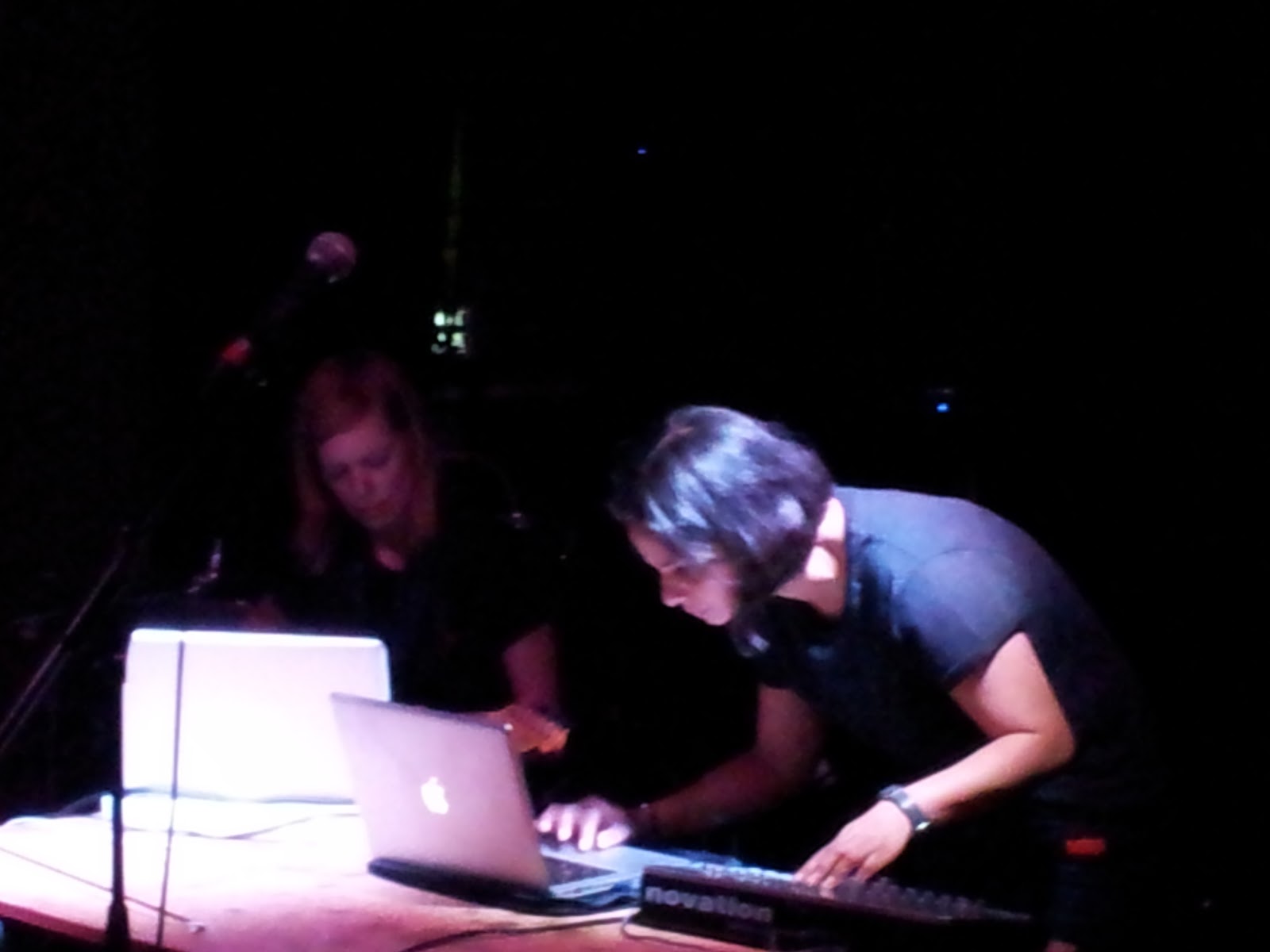
Supersonic is again a brave festival proposition, removing the obvious rock and alternative crutches of the mass sing-a-long or worshipful archive grave-robbing, and relying on the hypnotick and primitive power of its forms to keep the audience from chin-stroking nerd-dom. We saw some properly cracking stuff, topped by Richard Dawson, an unprepossessing bearded Northerner, with a ululating wail of a voice and a tear-jerking way with a folk story. A gob-smacking sequence of key-changes as he worked his way through "Poor Old Horse" (a simple but affecting tale of the botched execution of aforementioned equine) were as powerful a musical device as we heard amid all the laptops and tone generators. His gag about being surrounded by the ghosts of various grandparents and pets, playing as his backing band, was the funniest thing we heard all weekend, outside of the dare-you-to-laugh "Black Star" refrain that Modified Toy Orchestra deployed.

There wasn't great deal of real onstage charisma if truth be told, though what there was, was electrifying. Jarboe, for me, has been a spectral presence known only from the "Burning World" Swans LP and the terrifying "Anhedoniac". She took the very simple but appallingly effective route of just standing onstage and singing the songs; with the eye-rolling and entranced delivery she has, this was more than enough to grip. There are matter-of-fact lyrical gestures towards barely-imaginable torment and heart-stopping devotion, which Jarboe can deliver like a public service announcement.

Rock is a tired and tiresome form, so needs something de-stabilising to jolt it beyond cheesy posturing (yes, Six Organs of Admittance, I'm talking about you). The babyish and fraught contortions of the Doomsday Student (bad name, good idea) vocalist was the only convincing rock stage incarnation of the weekend. He gibbered, plucked, arched, grasped and groped while the band delivered a harsh traumatised punk rock, knowingly stylised and sleekly aerodynamic.

The finale was well-chosen by the curators; I only know Oxbow from barely-comprehensible inky reports of muscular performative confrontation. On this evidence, they've had criminally poor coverage: a stark and rhythmic string section gives the declamatory and distressed vocal plenty of room to manoevre, the gasps and guttural groans in the delivery all too close for comfort.

Camera Angle


These are two gloriously cinematic films, that certainly wouldn't have justice done to them on a television screen. Andrea Arnold puts an astonishing weather-beaten array of natural greens, greys and russets into the frame, and even squares off the frame itself to heighten the sense of claustrophobia and to avoid opening up the film to an easily-delivered vista-of-nature. Her camera follows Heathcliff from beating to hillside to stable, punctuating the barely-imaginable journey Arnold charts for him, from act of charity, to dark obverse, to return of the repressed, with sudden, harsh, raw panoramas.

It was a crying shame that a gruesome pluck-fest of a track by Mumford and Sons was allowed to spray itself over the final few frames and reduce my memory of parts of the film to nothing better than an impressionistic folk music video styled by Toast's Moorland Farm aesthetic.

Lynne Ramsay (maker of the glorious Morvern Callar)

Baest Beats That


Baest were once again entrancing and categorically slippery at the Club Surya gig last week.
There are frequent very gentle eruptions of Persian-carpet noise and clattering thickets of percussion that lunge towards us and then scatter like startled gazelles. The tracks take the form of impressionistic live-action watercolours in deep and awkward colours: Acid Stomp, Electro Noise, and Disassembled Dance. Constantly and colourfully unclassifiable stuff.

Sunday, 7 October 2012

Tanked

We  saw Hito Steyerl, a Berlin based filmmaker, and Rabih Mroue, a Lebanese artist, at the Tate Modern last night. Their double handed lecture was set in one of the chilly Tank galleries, a raw and almost refridgerated space built out of the previously derelict storage vats for power station oil. A very late start, unimaginative powerpoints and a 90-minute duration were challenges that my attention span was not up to meeting, unfortunately.

The essential ideas were very interesting: What happens or has happened when there is ‘remaining’ probability, after all the imaginable events have had their likelihood taken account of? Is there a space where all the impossible people or statements are able to exist? Steyerl and Mroue use some sleight of hand with storytelling, probability theory and film editing to open this spatiality, without every completely convincing.

They are both very engaging performers and artists (we particularly enjoyed Mroue’s “Pixelated Revolution” at dOCUMENTA, featuring his quietly impassioned and clear-eyed commentary on mobile-phone footage of police and army brutality, in which the user of the phone is shot while filming), but perhaps needed a collaborator with a more pedagogical style; the overall effect was of a presentation to the Tate curators for ideas for a project that had not yet been fleshed out.

Saturday, 1 September 2012

All Eyes On Korea

Jang Gyeong Kyu and the "Be Being" group were an entrancing proposition at the Purcell Room as part of the 'All Eyes on Korea' festival staged under the auspices of the 대한민국 문화원. A spectrum of strings, reeds, guitars a d percussion all contributed to a soundscape and melodic vocabulary that was never cluttered, though rasping and heavily textured, and delicately rhythmic. The discipline and restraint of the players was properly thrilling, and every element was tested and allowed to give an account of itself without being hurried on by an approaching chorus or ensemble flourish. It was a real treat to hear players asking eachother as many musical questions as they were playing 'together' in any obvious way.

Saturday, 25 August 2012

Tomorrow's World


Akira envisions the futuristic city through the retro-active means of the cartoon, while Alphaville does a perversely better job with the even more dated technologies of the effects-free noir gumshoe caper.

I don't speak any Japanese, but I can't imagine that the original dialogue is as breathlessly juvenile and hackneyed as the Americanised English that completely pulls the rug out from under any attempt at character development in Akira, and fragments the movie into one preposterously over-wrought and context-empty confrontation after another. There are some jaw-dropping visual tours-de-force, and the city is consistently affect-less and empty of anyone but helplessly crushed, eviscerated and torched populations. Adults are bumptious pawns; ageless, gnomic infants rule.

Alphaville is a wet, dark, oily place, punctuated with pristine white institutional interiors. The talk is laconic, bone-dry, hard-board; the characters believing so effortlessly in their own unreality that they need no sturm und drang to keep themselves powered. The most intensely present being in the film is undoubtedly the voice of Alpha 60, always answering back and demanding of the increasingly frantic private detective.

The future is harder to believe in, the brighter it gets.

Sunday, 5 August 2012

Kila "Soisin"

This is a very lovely instrumental folk record, apparently taking its inspiration from the memoir of an Irishwoman who became a Buddhist saint. The tunes are slowly rolling, plaintively repetitive melodies, drifting one into the next.
Theremin, strings, flutes, undemonstrative guitar and gradually unfolding flurries percussion are the simple ingredients that crucially don't get over exposed or overproduced in anything as crass as a solo.
None of the pieces are in any kind of hurry to get anywhere and all the more limpidly beautiful for that; "Cluainin" particularly takes most of its duration to get to its melodic point and still doesn't feel as if it is wasting any time.
The element of the music that struck me the most was how much in common it has with some of the North African and Korean 'traditional' music I've been listening to. The texture of stringed instruments, the emphasis on bowing, the intense attention to establishing melodic logic before pace or repetition become an issue. Evocative and heart-worn stuff.