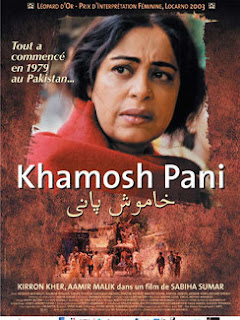
I only found out about "Khamosh Pani" (or "Silent Waters") through a colleague of Dr Roshini Kempadoo's, who mentioned the film in passing, while talking about his PhD research into the memories of partition as expressed in those who lived through them, and the cultural artifacts informed by the traumatic end of British imperial rule in India and the newly constituted Pakistan in 1947.
It's a gloriously humane film, taking on explosive elements of political history but succeeding in keeping a local frame around the narrative, and our sympathies with the female characters from the town. It's no coincidence that while the male characters are very morally active and noisy, it is within Ayesha's story and gravity within the plot of the film, that the ethical questions are asked and dramatised.
It's never actually occurred to me that I should be careful in this blog not to give away the endings of films or books; or at least that I should post a 'spoiler alert' if I'm doing more than reviewing- which is what I have been assuming I was doing most of the time.
One of the elements within 'Silent Water' that keeps the political and religious posturing, and our own reactions to it, from overwhelming the very understated story-line (Sikh brother returns to home town in Pakistan, half-aware that his sister might have escaped the filicidal and uxoricidal end of his family when the town was annexed by newly arrived Muslims), is the very pungent and textual attention to local domestic detail, fingers wiping rice and chapati from plates, Ayesha's careful sifting of grain in a large dish whenever she is thinking events over, the sympathetic street-shots, and the un-dressy interiors of bed, mat, picture and bowl.
This, and some of the same gender economy, is what links a small town near Rawalpindi in Pakistan with Incheon, the port and airport satellite city of Seoul in South Korea, where "고야이를 부탁해" (or "Look After My Cat") is set. Here too, the domestic interiors, cafes, tube-line landscapes are left to speak for themselves for long intervals, in a movie whose 3 main characters are girls in their first year out of high school, variously finding the route into womanhood an uncertain one. The urban and sub-urban journey-ings of the characters through the film take a good part of the place of dialogue between them, giving the film a rather beautiful and elliptical rhythm.
The unforgiving economics of a rapidly post-industrializing South Korea are dramatised quietly in the responses of Tae Hee, Hae Joo abd Ji Young to the sudden gulfs between them once school is over, (By far the noisiest and liveliest moment of the film is the first one, in which the girls wildly celebrate then end of their final school day, on the docks at Incheon with a camera), just as the equally relentless politico-religious logic of the re-formation of Pakistan's identity becomes the fuel for the drama of 'Silent Water'.
 This is a piece of pure, that is to say completely artificial and magical, cinema. It's a simple enough tale of silent movie star finding that technology and the studio system have discarded him, and his redemption at the hands of the young and hugely successful actress he'd given her first break.