Wednesday, 16 November 2011

Young People Nowadays


These are two gloriously cinematic films, which certainly wouldn't have justice done to them on a television screen. Andrea Arnold puts an astonishing weather-beaten array of natural greens, greys and russets into the frame, and even squares off the frame itself to heighten the sense of claustrophobia and to avoid opening up the film to an easily-delivered vista-of-nature. Her camera follows Heathcliff from beating to hillside to stable, punctuating the barely-imaginable journey Arnold charts for him, from act of charity, to dark obverse, to return of the repressed, with sudden, harsh, raw panoramas.

It was a crying shame that a gruesome pluck-fest of a track by Mumford and Sons was allowed to spray itself over the final few frames and reduce my memory of parts of the film to nothing better than an impressionistic folk music video styled by Toast's Moorland Farm aesthetic.

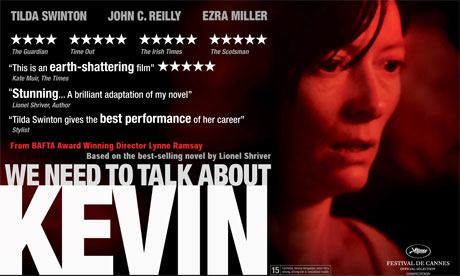
Lynne Ramsay (maker of the gloriously drifting film of Alan Warner's novel Morvern Callar) seems to get a lot more value out of her punctuations of curtains, diffused light, passers-by seen from cars, spacious-yet-ugly interiors. As far as I know, Tilda Swinton has never given a bad performance in a movie, and here she’s given more than enough time to put the viewer through the wringer with some desperately effortful mothering and blank, exhausted stares.

Tuesday, 15 November 2011

Life and Death


To my eyes, these are both films about the very thin line between life and death.

In Romero's gloriously low-budget, brutally trimmed schlocker, there's no explanation of the source of the Zombie manifestation. Soldiers (ignorant, coarse, desperate) and scientists (flaky, egg-headed, nerdy) are trapped underground, harvesting Zombies occasionally from the surface for the boffins to experiment on, and fruitlessly speculate over. At one point, one of the Zombies, called "Bud", is essentially being trained to be human again, as if death, or un-death, is nothing worse than a very severe case of amnesiac learning difficulty.

The survivors at the desert-island finale, in terms of representing that which in living humanity might be worth sparing a munching (and Romero certainly threw a good proportion of his dollars at the fake-flesh and blood FX department), are a white female scientist, who alone has managed to engage with the slouchingly violent and sniggering soldiery, a black philosophizing Caribbean helicopter pilot, and an alcoholic Irish radio operator. The ethnic and sexual economy of all this is pretty two-dimensional, but Romero should get some credit for a radical re-scaling of human value.

Conversely, in the Ring, the abrupt and terrorised deaths of a variety of young Japanese are found to be the result of a century-and-a-half old curse visited by the daughter of an unjustly persecuted female psychic. The moral economics are similar but on the other side of the life/death divide. The long-dead "mad" woman (or scientist, as she might have been seen in the mid nineteenth century) holds the ethical burden of an un-avenged, un-remarked death (the suicide of her mother). I don't have the cultural focus to interpret the precisely Japanese significance of the mother's suicide on the daughter; however the character able to reach across the life/death border here is a dead young woman, trying to drag others back across with her.

In Romero, it is the Zombie "Bud", in shooting the deranged soldier, who travels in the opposite direction, trying to follow the human escapees.


Thursday, 10 November 2011

Post-Industrial Graceland


Sean and I went to Birmingham in search of noise recently. We found it initially in the caustic hum of City Centre area kebab-joint fridges, and the very loud night-club attire of the Black Country's teens in search of joy at the various Vudus, Rages, Wasteds that litter the mainstream club map of the Digbeth- Bullring borders.

The Supersonic festival is set in a cluster of partially-reclaimed old warehouse and manufacturing buildings, under a vast redbrick railway arch. The vibe was almost embarrassingly relaxed and cheery, given the preponderance of devilry and gothdom on the t-shirts of our fellow noiseniks.

Essentially the discovery that the Capsule ladies have made is that Doom Metal is a folk music form and should be approached with the same taste for simplicity, repetition and and the re-telling of barely-acceptable stories below the mainstream media radar.

So we were treated to Wolves in the Throne Room purveying icy monolithic dirges, Orthodox taking the Latin liturgy and subjecting it to a statuesque and purposeful pummelling, and Electric Wizard essaying some old skool flourishes and some headbanging stylings straight out of the NWOBHM.

Pekko Kappi played a primitive Finnish 2-stringed wooden block, wailing to wonderful effect and introducing every second song as "another prison song"; the Secret Chiefs 3 staged a blinding hour and a half of hectic Balkan rocked-up prog-folk; Cloaks managed to siphon all the naff Funkyisms out of dubstep and slow the results right down; Mike Watt's gurning, restless and chafing 'opera' was compelling, and the gorgeously retro Warp electronica of Modulate showed just how great it can be to watch a bunch of 40somethings stare at their laptops and tone generators.

ATP's gonna have to step up to beat this.

Sunday, 2 October 2011

Music for Films

I've had a mixed time of it with German films recently.

Yesterday I finally got around to seeing 'Run Lola Run', which seemed to have been incorporated into recent European film history as a sharp existential crime thriller.

What I saw looked more like a dance music video, with a plot as restless, repetitive, autistic and twitchy as a mid-90's commercial techno track. Characters are too busy keeping pace with the 110 beats per minute, and the frenetically paced circular in-jokes and moralising flash-forwards to come alive. Lola herself looks fabulous in a vest and industro-red fright-hair, though resorts to shrieking her head off at several points at which some decent dialogue or character acting would move the film forward.

All this reminded me of the tone and effect of The Edukators, which pressed the button marked "Indie-Grunge Emoting Soundtrack" far too frequently to establish anything close to a living character on the screen; and likewise tried to cash far too many cheques on the account of Smouldering Youthful Libido to establish motivation and history believably. It's theoretically-interesting theme of lost idealism was completely vapourised by a relentless focus on the political thrashings and jealousies of three self-regarding twenty-somethings who have not lost enough of anything to be worth the attention the film gives them.

Even more tragic was the case of "Goodbye Lenin", which spent a heart-rendingly huge amount of effort and attention to detail in recreating the design and appearance of immediately pre- and post- Berlin Wall falling Germany, and then only remembered where the emotional centre of this would be for one brief shot (the mother accidentally leaving the apartment block and discovering the 'new' world). Before and after this, a slapstick freneticism and fast-cut 1-second attention span style predominated.

The German movies I've seen recently that really grabbed me were about older, more compromised people: Downfall, and The Lives Of Others. But that's another story.


Sunday, 25 September 2011

Bonne Vacances


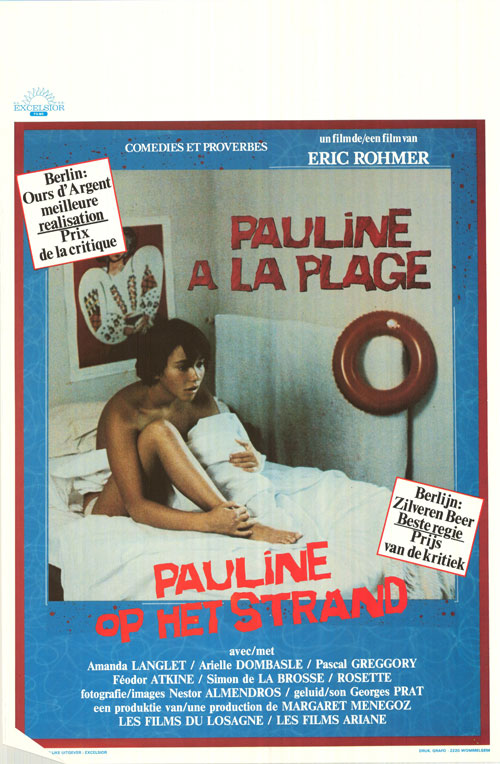
This is a seaside-destination holiday film that has a beautifully judged scent of torpor, emptiness, drift, dog-day, and inconsequentiality.

A believable teenage girl (why do French actresses effortlessly do Teenage, while their Brit equivalents are struggling to be any more convincing than Byker Grove) visits a tatty seaside town with her paralysingly beach-ready and hopelessly self-regarding cousin, on the rebound from a brief failed marriage. Men notice them. There is flirting and posturing from the adults, already far too attached to their dramas.

The most wonderful element to this is the disregarded, unhip, virtually deserted town all the heaving sexual gamesmanship (and gameswomanship) plays itself out against. There's literally no audience worth the mention for the adults' arch, bored manipulation of eachother. Beautifully judged stuff.


Saturday, 17 September 2011

Family Snapshot

"Tokyo Story" is a static and glacially paced film, with the camera consistently below the eyeline of a person sat on a mat on the floor. Slightly dowdy, dusty interiors, shot from the disregarded far sides of rooms, lit by diffused sunlight and un-shaded bulbs predominate.

I've never seem Kabuki theatre before, but assume that the quietly effective use of the almost unchanging expressions on the mother and father's faces, is what gives the power to their responses to the bumptiously, offhandedly graceless behaviour of their children, whom they've travelled a long distance to Tokyo to see.

There's genuine heartbreak in the moments when the preoccupation of in-laws and high-minded social probity mean that the elderly parents are essentially homeless for the night, and simply work out for themselves where they might best be housed.

It's a very simple moral universe, but a wonderfully restrainedly drawn one.

Wednesday, 14 September 2011

Kitchenette

It's a brilliantly titled play, as even the characters don't have surnames; they're identified only as 'Peter, grilled fish', 'Hans, fry', 'Gaston, grill'. The set is a cluttered dance-floor of a space, with some wonderful choreographed moments of stirring, whisking, spooning, and triumphant pouring and a celebratorily deranged act-ending danse-culinaire.

The pan-European staff lapse into French and German, East-End slang regularly, giving the dialogue a smorgasbord texture, and Tom Brooke as Peter, the German fish cook is noisily the best of the cast: aloof, arch, stagey and very fragile.