Monday, 4 October 2010

Wasted Lives


Nick Cave can still grind out masterful couplets, probably jotting a dozen down before breakfast most days. "How many of you been wasting your lives/ On booze and drugs/ husbands and wives?"

Grinderman, playing especially in the slightly peeling, unpleasantly branded'n'sponsored, pink trifle of an interior that is the Hammersmith Apollo, are a splendid object lesson in Keeping It Simple.

These are songs about the wailing, flailing, obstreporous, vindictive tides of men's desire, and they never outstay their welcome or lose their sense of the ridiculous. There's rudimentary but fearsomely effective drums and bass, Cave's slash'n'burn guitar hysterics, and the wonderfully decorative but absolutely essential violin, bouzouki and maraca abuse provided by Warren Ellis, whose presence is symbolic of only the centrality of posture, hair, sweat and stare.


Saturday, 11 September 2010

Be Quiet! We Can't Hear the Noise.


Our first visit to Cafe Oto, which is shamefully close by. It's an absolutely wonderful venue: Despite showcasing some of the most experimental, earsplitting music imaginable, the system is wonderfully understated, just filling the room with sound, letting your presence in the space be enough exposure to the noise. They also have an excellent alcohol policy: An amateurishly biro-ed sign propped on the bar announces "No sales during the performances".

This was absolutely essential during the solo cymbal with mixing/processing by Oceans of Silver and Blood. Long episodes of clanging, chiming silence, gradually shifting rise-and-fall of frequency reverberation. The cymbal player was out of sight behind his huge tam-tam, which added to the drama. "When's the next noise coming"?

ARAR had charmed us with home-made radio transmitters, simple jury-rigged wave-form machines and a sound propelled by the humane ebb and flow of bass frequency.

Monday, 6 September 2010

Good Dog, Good Dog

We were at the Oxford Playhouse last Friday, for 40 minutes of brilliantly delivered relationship analysis through Lassie, Who's Afraid of Virginia Woolf, and fearless self-examination. Stacey Makishi and her real-life partner Vick act out, in every sense of the phrase, a stream-of-consciousness dream sequence fuelled by the vivid visual and cinematographic residue of the thrashing, repetitive, resigned end of a relationship.

There are several tours-de-force: Vick pours water from a jug while stood at the top of a metal stepladder, into Stacey's mouth while she lays flat on her back at the base of the ladder, trying to sing through the waterfall; they both sit opposite each-other at a white-covered table, a pillow, a knife, and a black glove each between them and dinner when they both leap onto the table and eat like dogs.

Excellent visceral stuff delivered with gusto and good grace.

Monday, 30 August 2010

Ever Seen A Butcher Smile?

&sourceFile=028312As always, the music is beautifully placed and judged, which is the marker for a film that is likely to be the same. (Michael Chion: "Sound is the principle means by which consistency and coherence are maintained and stimulated in cinema"). There's no music track at all during the 'action', or dialogue in "Eyes Wide Open"; simply the brief interludes, barely a minute long, feature some brief sketches of piano or string, repetitive short sequences of notes, playing the part purely of a Nothing, a breathe-in, a punctation mark. This technique places huge demands on the dialogue and the silences within the dialogue; as if to say: there is nothing in this film apart from what the people are doing and saying, and the music only occurs to remind the viewer of this point, and adds an exactly-judged Nothing to highlight it.

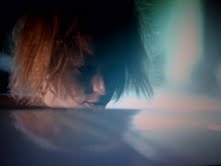
On the face of it, it's a just another dark love triangle. The most powerful scenes are really those between the butcher and his wife; heartbreakingly, she is only too aware of what he is doing at the shop, but carries this and confronts him with all the kindness and tact she can. The scene where the rabbi defends the butcher from the mob, but only at the cost of his ability to reason and convince, purely invoking his authority, is a desperate one. The film is a wonderful exercise in keeping-it-simple; there are no long sequences of speech, even from the Rabbis.

Frankfurt to Wiesbaden

There's a deceptively light social comedy style about this that manages to almost entirely mask the horrifying naivete, self-deception, broken trust and shallow propriety that fuel the wonderfully slight plot. As Ian McEwan does these days, with a great deal more portentousness and pomp, the faintest shift of events has consequences of hinted-at remorseless carnage. The climactic, almost apocalyptic horse-ride into the forest has left me actually quite shaken. You can probably get this for 99p on Amazon.

Friday, 27 August 2010

... Stands For Comfort

We were out at the Rio on Thursday night for the newest film by the maker of the brilliant and eye-popping "괴물", "Host", 봉준호 (Joon-Ho Bong).
A mother doggedly searches for those responsible for framing her son for the lurid and theatrical murder of a sexually precocious schoolgirl. It's not really a crime thriller though.
The male lead, such as he is, is played beautifully and subtly by Bin Won, and essays a vulnerable, autistic, hesitant, virtually directionless character.
The libido of the plot is entirely driven by the mother's relentless, innocently single-minded pursuit of the invisible, the hidden, the ignored, the conveniently forgotten. This takes her to some bleak scenarios, but the locales are never allowed to overwhelm her sense of purpose.
There are some visual tours-de-force: A golf course at first light, a man picking a driver out of a lake and wading to the bank with it. The mother pours soup into her son's mouth as he pisses against a blue-grey concrete wall by a bus stop.

There's an echo of Laura Palmer in Ah-Jung, as she wonders aloud about the explosive contents of her mobile phone photo folder, and an extremely unflattering portrait of the men of the legal and medical professions in small-town Korea in the reptilian and unctuous lawyer.

The mother's wonderfully judged awkward encounters with the town's schoolgirls, and the unblinking relationship they have with the denied world that Boon can hint at with his bored functionaries, offhand policemen, and self-serving institutional place-men, are compelling and nervelessly drawn.

Sunday, 8 August 2010

Family Snapshots


Two films about families at war, with themselves, with each-other, and with the world at large. "Wasp" is a short by Andrea Arnold (maker of the brilliant "Red Road"), that plunges the viewer straight into the torrent of anger, pride and depthless devotion between a mother and her 4 daughters living on an unnamed estate somewhere in Essex. It's impossible not to hope that the children manage to keep themselves amused and safe outside a brutal bungalow-pub while their mother ekes out the couple of pounds she has trying to turn an old flame home from the army into boyfriend material, while trying to explain the children's presence away to him. Desperate and compelling stuff; I'm not sure if I cold have stood up to more than 25 minutes of that sort of tension, so the short format was just as well.

"The Brotherhood" (Tae Guk Gi) is a vast flashback of a war film, which derives all its power from the short sequences at the outset, framing the gunfights and civilian deaths in a search for the body of a lost 'other', a brother captured by the North Korean army and apparently turned into the leader of a terrifying elite unit. It's impossible not to see the enactment of a hoped-for reunification of North and South in the recovery of the older brother's body and the uncovering of the post-war life he had hoped for had he survived the war. The tools for progress in the future are firmly buried in the most violent moments from the past.